Data Visualization
Makeover: Shared Micromobility Data
Ideal transportation data is like ideal transportation: accessible and easy for everyone.
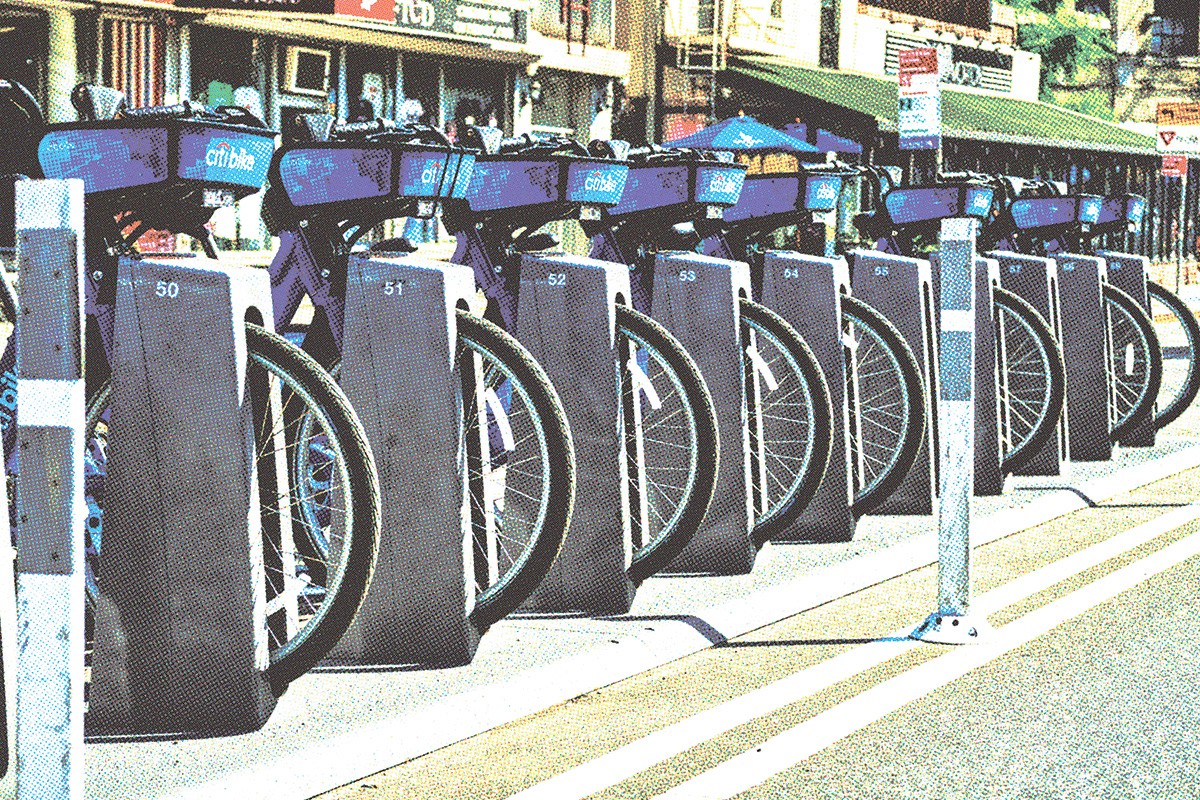
Shared micromobility systems first appeared in North America back in 2009. They offer short-term use of a device like a bicycle or scooter and can be a convenient and effective way for people to move throughout a city. You may have a system where you live or seen one while traveling.
My personal use of shared micromobility systems has been limited thus far. However, I am a believer in their potential to reduce our reliance on car travel and to make transportation more equitable. So I was excited to come across this post by The League of American Bicyclists that charts the prevalence of shared micromobility systems in U.S. cities.
A few things seemed clear initially:
The number of cities with systems—regardless of type—grew steadily until around 2018 or 2019.
E-scooters have become more prevalent in recent years.
There was a downturn in 2020, then a spike in 2022.
The version published on The League of American Bicyclists’ website is interactive and omits the confusingly placed labels on the chart, but I still struggled to digest all that was there and had questions I couldn’t easily answer. So I decided to take a closer look and explore how else the data could be presented. Before getting started, I outlined some goals:
Reduce complexity to convey the key takeaways
Understand the prevalence of each mode (e.g., docked bikes)
Investigate trends in the number of multi-modal cities
Look beyond the total to understand possible “churn” in cities
Let’s walk through each goal and the resulting visuals:
1. Reduce complexity to convey the key takeaways
There’s a lot going on in this chart.
The eight categories are stacked atop one another. This makes it reasonably easy to compare the cumulative value of all eight categories over time, and you can make similar comparisons for the bottom category. However, the middle categories are more difficult to compare because their top and bottom boundaries both move over time. The thickness of a category can increase even while its top boundary shifts downward. In this case, I think a line chart is easier to interpret. Since the lines won’t be stacked, a line representing the total number of cities across categories will be added.
2. Understand the prevalence of each mode
Another difficulty lies within the category encoding itself. There are eight categories because each possible combination of three modes (plus campus systems) is represented. This may be helpful for certain questions, but it means more work to answer a basic question such as “How many cities have e-scooters?” To answer this, you must sum up four categories that include e-scooters: e-scooters only, docked bikes and e-scooters, dockless bikes and e-scooters, and all micromobility options. While it sacrifices the ability to see specific modal combinations, each of the three individual modes will be displayed as lines.
Lastly, I decided to omit the campus systems category. It represents a relatively small number of cities but, more importantly, is not specific to certain modes. Because these systems are designed to serve a limited geography within a city (i.e. a college campus), they also feel less relevant.
Here’s the result:
The headline and annotation above reinforce the most important takeaways. We can also easily see that around 50 cities each have docked or dockless bikes. With the number of cities with “dockless bikes only” dwindling to a handful from 2021–2023 in the original chart, it may have been missed that about 40 cities had dockless bikes and e-scooters during the same years.
3. Investigate trends in the number of multi-modal cities
With the line graph simplified to show each mode individually, I still wanted to understand the number of modes available in cities over time. I suspected many cities may have started with only one mode, but another was added later. This was a likely explanation for a decline in the number of cities with dockless bikes only at the same time cities with dockless bikes and e-scooters increased. I decided to turn back to a stacked area chart but use just three categories for the number of possible modes.
Most cities do still feature just one mode but, as expected, the number of multi-modal cities rose steadily through 2019.
4. Look beyond the total to understand possible “churn” in cities
There are plenty of other places this data could take you. This is, after all, just the number of cities with systems. The size of those systems and their ridership are important pieces to more fully understand what is happening with shared micromobility in the country. But my immediate questions were still focused on the cities themselves. Are 2020 and 2023 the only years that systems moved out of cities? When the total number of cities remained stable, were there still changes happening? To answer these, I went back to the original Bureau of Transportation Statistics data, recording the year a system was first introduced and, if applicable, the year it was removed for each city. There are some specialized chart formats to display gains and losses, but a stacked bar chart with positive and negative values does the job here.
The positive side of the bar mirrors the trend we’ve seen in earlier charts, but the red and blue sections add a new layer of information. The total number of cities first declined in 2020, but there were even more changes a year later; the loss of 52 cities from 2020 to 2021 was obscured by the addition of 50 more. Despite growth in some recent years, a high number of cities losing systems signals that retaining (and maintaining) current systems may be a more important short-term challenge than expansion into new cities.
There’s no right way to present these data points. With a diverse audience and limited time/space, effectively communicating your message can be a real challenge. An effective approach, though, is often a simple one.